


DataGPT Shut Down: What Happened & Best Alternatives

If you are looking for DataGPT, stop. DataGPT has shut down.
The evidence is definitive: product pages return 404 errors, LinkedIn shows a mass exodus of employees, and the founders have scrubbed themselves from the company page.
This leaves a gap for teams relying on their conversational AI analytics. Here is the candid breakdown of what happened, what the tool actually was, and—critically—where you should move your data workflow now.
TL;DR: The Quick Summary
- Status: Officially offline as of late 2025.
- The Signs: 404 errors everywhere, team departure, founders gone.
- The Product: Conversational AI analyst (expensive: $10K-$30K for 3-month pilots).
- Likely Killers: Pricing friction, commoditized market, enterprise-only pivot.
- Where to go now:
- AI-Native: BlazeSQL (reliable self-service)
- Pixel-Perfect Reporting: Power BI or Tableau
- Search-based: ThoughtSpot (enterprise search analytics)
Not sure which path fits your team? Use this quick assessment to match your priorities.
Choosing between DataGPT alternatives can be confusing—pricing models, AI capabilities, and self-service features vary widely. Get a personalized recommendation based on your team size, technical expertise, and budget.
What Was DataGPT?
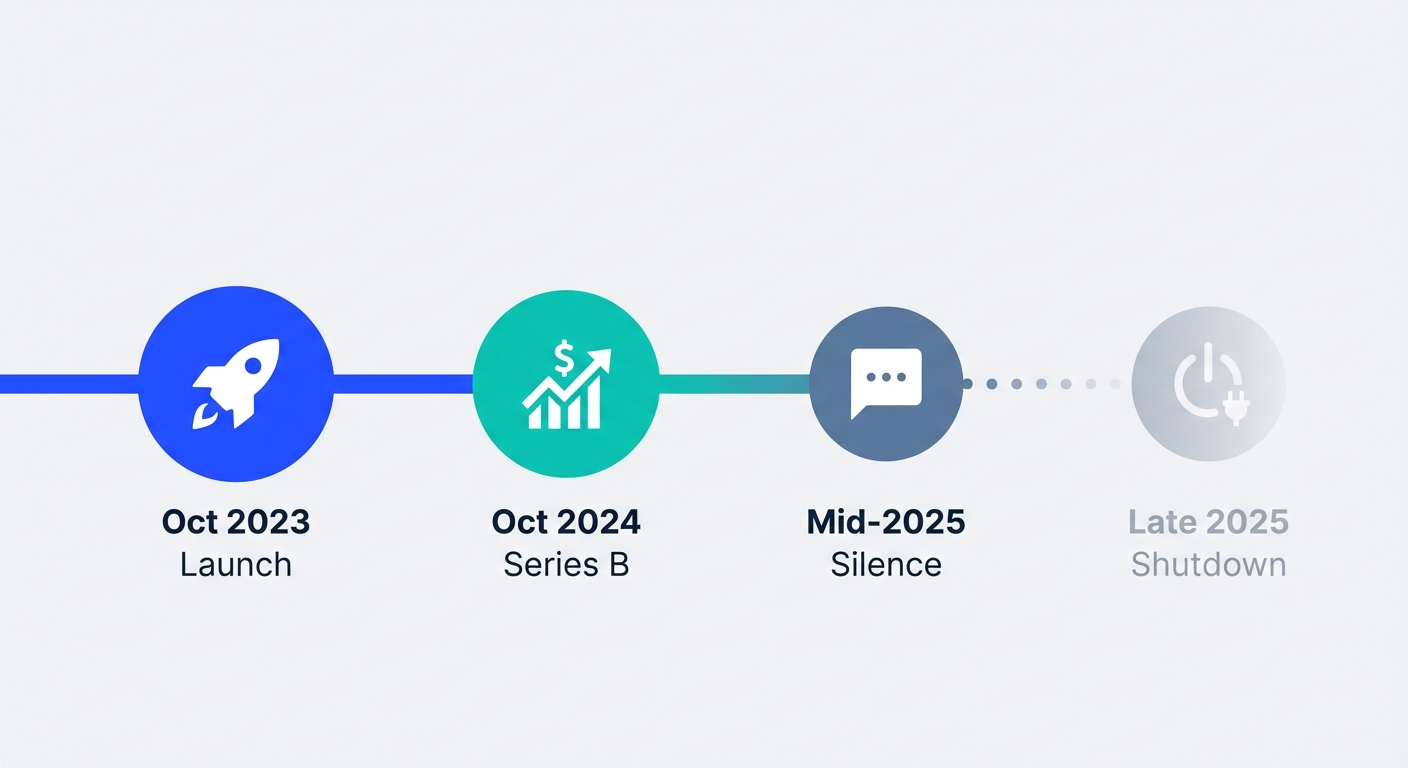
DataGPT marketed itself as a "conversational AI data analyst." The pitch was simple: ask plain English questions, get instant charts and analysis. They launched in October 2023 and raised about $22 million, including an $11.9M Series B in October 2024.
The Pitch
- Natural language querying: "Why did churn spike?" -> Automated answer.
- Proprietary engine: An LLM combined with "Lightning Cache" for speed.
- Root cause analysis: Automated drill-downs into metric changes.
- Connectors: Standard hookups for Snowflake, BigQuery, Redshift, etc.
The Tech Stack
They used a three-layer architecture:
- Lightning Cache: In-memory database claimed to be "90x faster" than traditional options.
- Core Analytics Engine: Handled the math and statistical tests.
- LLM Layer: A mix of self-hosted LLMs and OpenAI embeddings.
They fought hard to prove they weren't "just a SQL wrapper," positioning themselves against both old-school BI and simple text-to-SQL tools.
What Happened?
Late 2025: Lights out. No press release. Just silence.
- Website broken: Login, blog, and signup pages are dead (404).
- Team gone: LinkedIn shows almost zero remaining employees.
- Radio silence: The last verifiable blog posts dropped in mid-2025.
They had $22M in the bank and logos like Papa Johns and Plex. But between the October 2024 raise and late 2025, operations collapsed.
Why It Likely Failed
We don't have the internal post-mortem, but looking at the market data, four factors likely killed it.
1. Extremely High Pricing Friction
DataGPT demanded $10,000 for a 3-month pilot. Enterprise tiers hit $30k+.
- No free trial.
- High risk for unproven ROI.
- Impossible for smaller teams or startups to adopt.
For context, Power BI is $10-20/user. Asking for $10k upfront without a "magic moment" is a tough sell. Without the ability to validate quickly, teams can't justify the spend.
2. Everyone Else Caught Up
In 2023, chatting with data was magic. By 2025, it was a standard feature.
- Microsoft: Power BI Copilot.
- Salesforce: Tableau Pulse.
- Google: Looker + Gemini.
- Amazon: QuickSight Q.
DataGPT's differentiator became table stakes for the incumbents.
3. Abandoning the Low End
In mid-2024, they had a $99/month "Xpress" tier. By late 2024, they killed it. The minimum price jumped to an equivalent of ~$3,333/month.
Pivoting to enterprise-only means fighting Microsoft and Salesforce for long sales cycles. That's a brutal battle for a startup.
4. Big Claims, Little Proof
They claimed "90x faster" speeds and "zero hallucinations."
- Security pages were 404ing before the shutdown.
- No independent verification of the speed claims.
- SOC 2 docs were claimed but inaccessible.
For an enterprise buyer, inaccessible compliance documentation is a massive red flag.
Best DataGPT Alternatives
If you need to replace DataGPT (or were about to buy it), here are the actual viable alternatives.
Traditional BI Platforms with AI Features
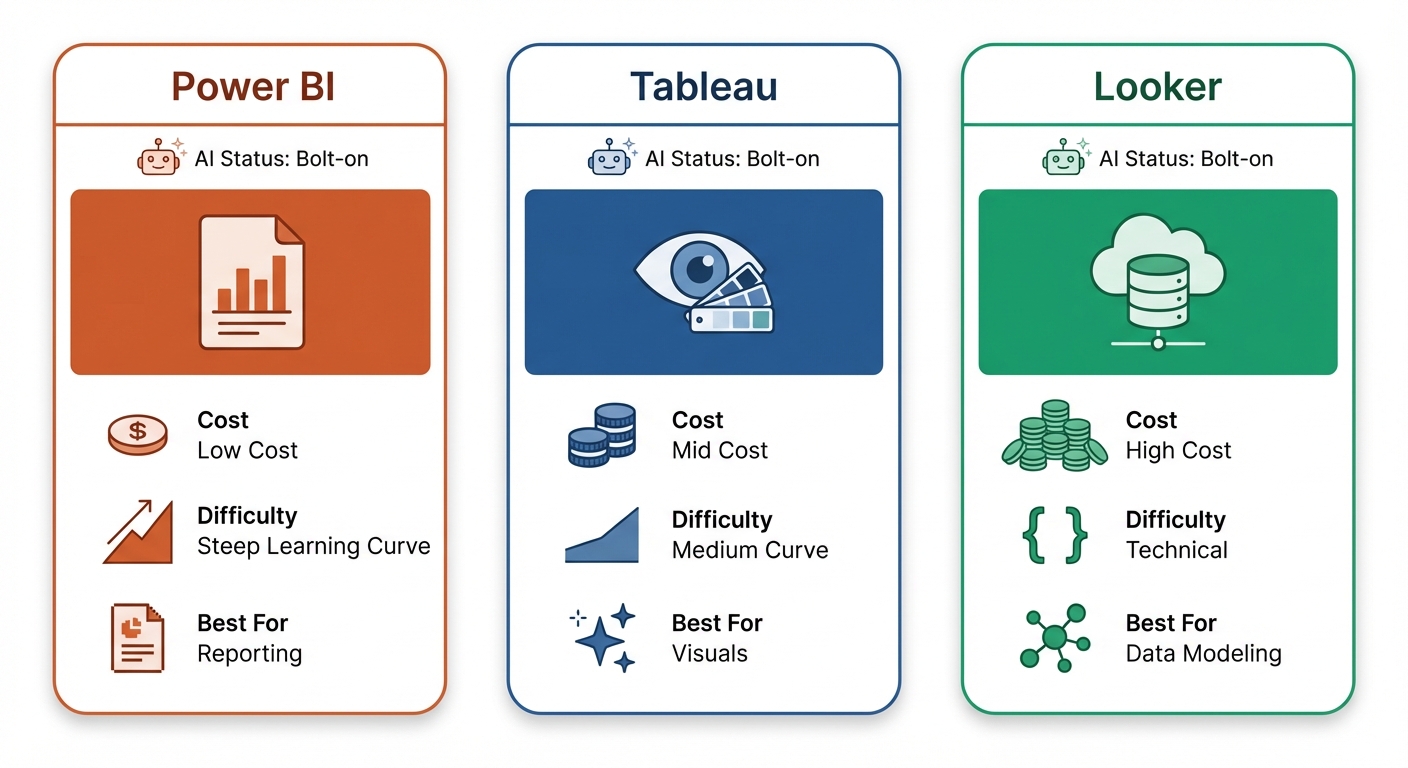
These platforms have deep feature sets for pixel-perfect reporting, branded outputs, and complex data modeling. Their AI features are typically added on top of the existing architecture.
Microsoft Power BI
Best for: Microsoft shops needing polished reports.
Power BI Copilot adds Q&A to the massive existing platform. It works, but usually requires your data models to be pristine.
- Pricing: $10-20/user/month (Copilot needs Premium).
- Strengths: Deep Microsoft integration, huge community, pixel-perfect paginated reports.
- Limitations: Copilot can be hit-or-miss; DAX is still a steep learning curve.
Tableau
Best for: Teams prioritizing beautiful, branded visualizations.
Tableau Pulse provides proactive insights, and Einstein Copilot handles the chat. The visuals are still the industry standard for executive presentations.
- Pricing: $15-75/user/month.
- Strengths: Best-in-class visualizations, extensive formatting control.
- Limitations: Gets expensive fast; AI feels separate from the core workflow.
Google Looker
Best for: Google Cloud teams with LookML expertise.
Uses Gemini for natural language queries. Powerful if you invest in the LookML semantic layer.
- Pricing: Custom (read: expensive).
- Strengths: Strong governance via LookML, tight BigQuery integration.
- Limitations: Heavy technical lift to set up; opaque pricing.
AI-Native Analytics Platforms
These tools were built around the LLM workflow from day one, not retrofitted. The key metric here is reliability—can the AI handle messy business logic without hallucinating?
The difference between bolt-on AI and purpose-built AI is like asking a general practitioner to do heart surgery versus going to a cardiologist. Both are doctors, but one was specifically trained for the task.
BlazeSQL
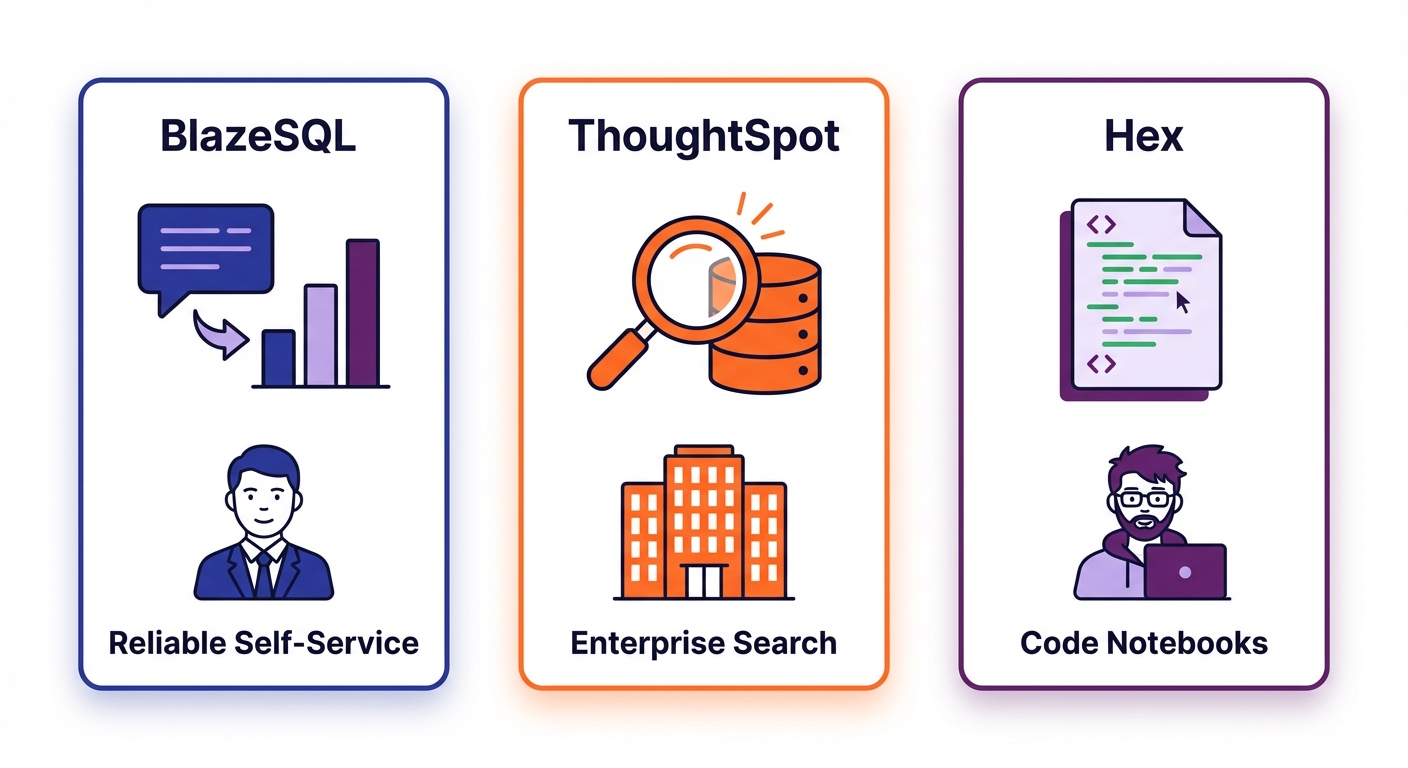
Best for: Teams wanting reliable AI self-service without the learning curve.
BlazeSQL connects to your SQL database and focuses on the "ask and answer" workflow. Unlike generalist tools that bolt on AI, it includes specific features to make the AI actually reliable in production.
- Pricing: Starts ~$400/month (3 users).
- Strengths: Built for reliability (knowledge notes, training questions, query review); works for both technical and non-technical users; dashboards and visualizations included.
- Limitations: Fewer chart variations and less pixel-perfect formatting than Tableau; cloud-based (desktop version available for data residency).
The differentiator here is operational reliability. Instead of promising "zero hallucinations" (which is impossible), BlazeSQL gives you tools to train the AI on your specific business logic—like metric definitions, exclusions, and non-obvious joins—and lets you review generated queries for transparency.
ThoughtSpot
Best for: Large organizations with budget for search analytics.
They did "search-based analytics" before AI was cool. Spotter AI is their modern LLM integration.
- Pricing: Custom (~$95-125/user/month).
- Strengths: Mature search interface, extensive enterprise features.
- Limitations: Expensive; complex setup; heavy semantic modeling required upfront.
Hex
Best for: Data Scientists who live in notebooks.
Notebook-style analysis with AI assistance. It's powerful for Python/SQL pros, not for the marketing manager who just wants a chart.
- Pricing: Free tier; paid from $20/user/month.
- Strengths: Great notebook interface; collaboration features.
- Limitations: High technical floor; not built for non-technical self-service.
Open-Source and Self-Hosted Options
On a budget or need to host it yourself? Look here.
Metabase
Best for: Self-hosted, simple BI on a budget.
Clean, popular, and recently added basic NLP features.
- Pricing: Free (open source); Cloud starts at $85/mo.
- Strengths: Easy setup, great community, low cost.
- Limitations: AI features are basic compared to commercial tools.
Apache Superset
Best for: Technical teams who want total control.
Airbnb's open-source project. Very powerful, very technical.
- Pricing: Free (open source).
- Strengths: Zero licensing cost; highly customizable.
- Limitations: You are the support team.
Cloud Data Platform AI Features
Already paying Amazon or Snowflake? Check their native tools first.
Amazon QuickSight Q
Best for: AWS-heavy organizations.
- Pricing: $3-24/user + $250/mo for Q.
- Strengths: Pay-per-session pricing; native AWS integration.
- Limitations: AWS lock-in; limited analytical depth compared to dedicated tools.
Snowflake Cortex
Best for: Snowflake-only data stacks.
- Pricing: Usage-based (credits).
- Strengths: Data never leaves Snowflake; tight integration.
- Limitations: Only works on Snowflake; needs perfect schema naming to work well.
DataGPT Alternatives Comparison
| Tool | Category | Starting Price | AI Approach | Self-Service | Best For |
|---|---|---|---|---|---|
| Power BI | Traditional BI | $10/user/mo | Bolt-on (Copilot) | Medium | Microsoft shops, pixel-perfect reports |
| BlazeSQL | AI-Native | ~$400/mo (3 users) | Purpose-built | High | Reliable self-service, mixed teams |
| Tableau | Traditional BI | $15/user/mo | Bolt-on (Einstein) | Medium | Branded visualizations |
| ThoughtSpot | Search Analytics | ~$95/user/mo | Core feature | High | Large orgs with modeling capacity |
| Metabase | Open-Source | Free / $85/mo | Basic | Medium | Self-hosted, budget-conscious |
| QuickSight | Cloud BI | $3/user/mo + Q fee | Native AWS | Medium | AWS organizations |
| Hex | Data Science | Free / $20/user/mo | AI coding assist | Low (technical) | Data science teams |
How to Decide
Here is the heuristic I would use to pick a replacement:
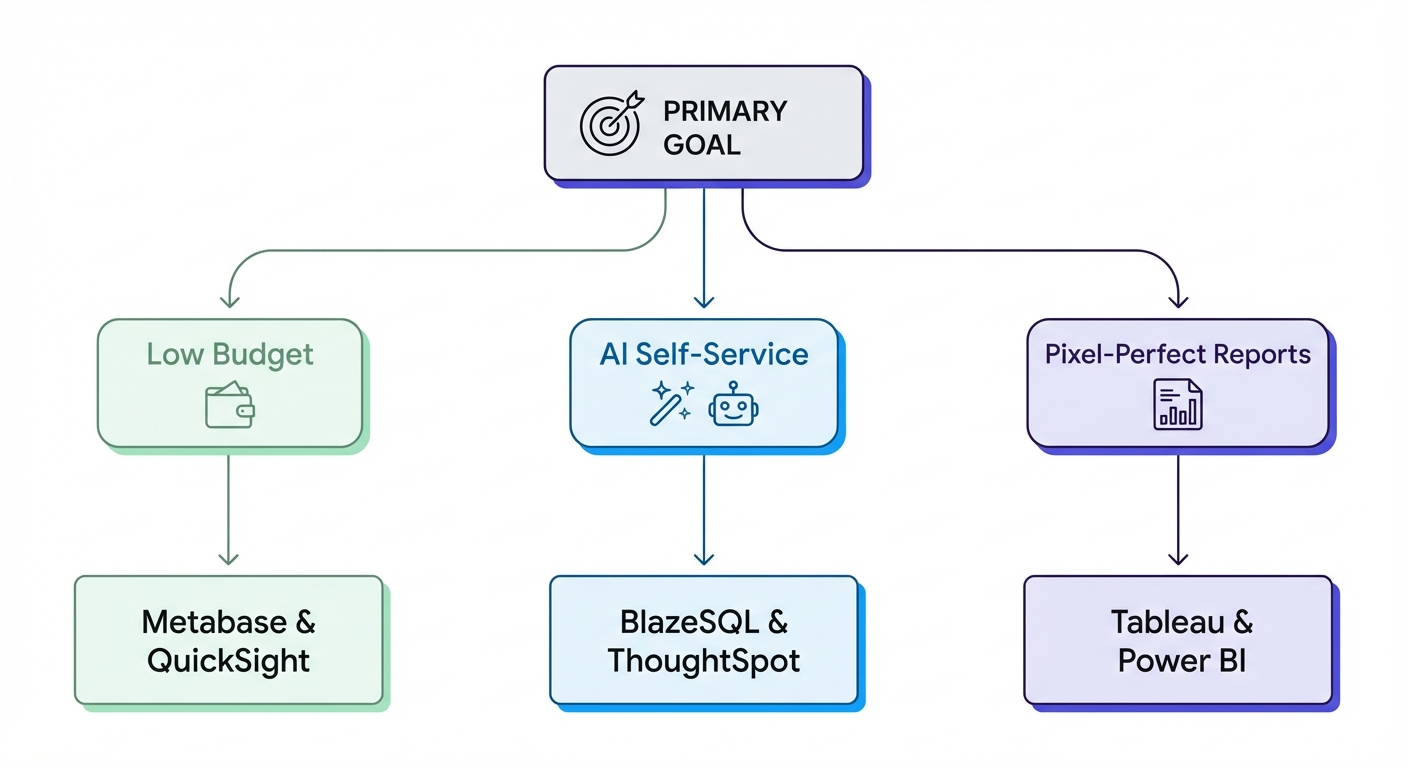
- You have a non-technical team needing answers: Go BlazeSQL or ThoughtSpot. You need a tool built for questions, not dashboard-building.
- You need pixel-perfect, branded reports: Power BI or Tableau. They have decades of formatting options.
- You have a team of SQL analysts: Any of the above work; consider Hex for advanced notebook work.
- You have zero budget: Metabase (Open Source).
- You live in the Microsoft ecosystem: Just use Power BI Copilot. It's the path of least resistance.
- You need to replace an analyst bottleneck: AI-native tools (BlazeSQL) are your best bet to offload repetitive request volume.
Not sure where you fall? The assessment can help narrow it down based on your specifics.
Get personalized recommendations based on your team size, budget, and technical requirements.
Lessons from the DataGPT Shutdown
If you're evaluating tools, don't make the same mistakes DataGPT's customers did.
1. Pricing Friction is a Killer
A $10k minimum with no trial is a gamble. Always look for a free trial or low entry point to validate the "magic" before signing a massive contract.
2. AI is a Commodity, Reliability is Not
"Conversational AI" is everywhere. The differentiator isn't having AI; it's whether the AI works reliably in production with your messy, real-world data.
3. Verify Claims
"90x faster" and "Zero hallucinations" are marketing fluff until proven. Check G2, check Reddit, and ask for case studies with hard numbers.
4. Check Documentation Accessibility
DataGPT had 404 errors on security pages before they died. Always check the boring stuff: Are docs updated? Is the blog active? Can you actually access compliance documentation?
5. Bolt-On vs. Purpose-Built
This is the key distinction in AI tools. Incumbents are bolting AI onto architectures built decades ago. It works—but often requires perfect data models and heavy setup. Purpose-built tools usually handle the nuance of business logic better because they were designed for natural language from day one.
Important Note: The Other "DataGPT"
There is an open-source GitHub repo called "DataGPT" (github.com/digai-co/DataGPT). This is unrelated. It's a separate open-source project for generating charts from databases. Don't confuse the two.
Wrap Up
DataGPT's $22M collapse proves that funding doesn't equal survival. The market moved too fast, and they got squeezed between cheap incumbents and specialized AI-native tools.
Your next move depends on your priorities:
- Reliable Self-Service: BlazeSQL.
- Pixel-Perfect Reporting: Power BI or Tableau.
- Budget Conscious: Metabase.
- Search Analytics at Scale: ThoughtSpot.
Pick the tool that fits your team's actual technical reality and reporting needs, not the one with the flashiest marketing video.
Power BI's DAX is incredibly powerful but the learning curve is steep. Copilot helps but it's not magic—you still need to understand your data model.
View on Reddit